


1. What Is a Portable Power Station?
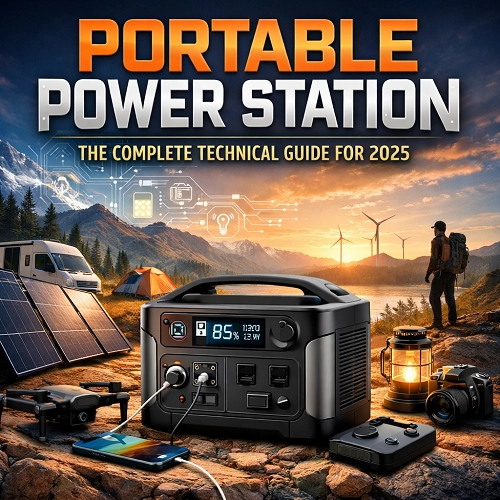
A portable power station is a self-contained, rechargeable battery system that integrates an inverter, charge controller, battery management circuitry, and multiple output interfaces into a single transportable enclosure. Unlike conventional fuel-powered generators, portable power stations operate silently, emit zero exhaust, and can be recharged from wall outlets, vehicle 12 V sockets, or photovoltaic panels.
The market has matured considerably since early lithium battery packs appeared around 2015. Today's devices span a capacity range from compact 300 Wh units intended for day hiking to 5 kWh+ stations capable of sustaining a household refrigerator, medical devices, and lighting for multiple days. Sunohoo Technology's portable power station product family exemplifies this spectrum, covering seven distinct power tiers from 300 W through 5,500 W.
2. Battery Chemistry: Li-ion vs. LiFePO₄
The battery cell is the single most consequential component in any portable power station. Two chemistries dominate the market: conventional Nickel Manganese Cobalt (NMC) lithium-ion, and Lithium Iron Phosphate (LiFePO₄, or LFP). Understanding the differences is essential for making an informed purchase.
Lithium Nickel Manganese Cobalt Oxide (NMC)
NMC cells offer high energy density — typically 150–220 Wh/kg — which allows manufacturers to build lighter, more compact units. However, the cobalt-rich cathode is thermally less stable; runaway events, though rare with good BMS design, release more energy. Cycle life generally spans 500–1,000 full charge/discharge cycles before capacity falls below 80 % of rated value.
Lithium Iron Phosphate (LiFePO₄ / LFP)
LFP cells sacrifice some energy density (90–160 Wh/kg) for substantially greater thermal stability and longevity. The iron-phosphate bond is far harder to break than the cobalt oxide bond, meaning that even at high temperatures the cathode does not release oxygen — the trigger for thermal runaway. Cycle life commonly reaches 2,000–3,500 cycles, and premium cells can sustain 80 % capacity past 4,000 cycles. Sunohoo's portable power stations are built around LiFePO₄ technology, which aligns with their focus on long-service-life, safety-first energy storage solutions.
| Property | NMC Li-ion | LiFePO₄ (LFP) |
|---|---|---|
| Nominal cell voltage | 3.6 V | 3.2 V |
| Energy density (gravimetric) | 150–220 Wh/kg | 90–160 Wh/kg |
| Cycle life to 80 % capacity | 500–1,000 | 2,000–4,000+ |
| Thermal stability | Moderate | Excellent |
| Self-discharge per month | 1–3 % | 2–3 % |
| Operating temperature range | −20 °C to +60 °C | −20 °C to +70 °C |
| Cobalt content | High | None |
| Cost per Wh (2024 trend) | Lower | Competitive / falling |
"LiFePO₄ chemistry is not simply a battery; it is a long-term investment in reliability — cycle life that translates directly into years of guaranteed backup power."
3. Battery Management System (BMS) Architecture
The Battery Management System is the electronic guardian of every cell in the pack. Without a robust BMS, even the most chemically stable cells become dangerous. A professional-grade BMS — as employed across Sunohoo Technology's portable power station range — provides the following protection layers:
Cell Balancing
Individual cells within a battery pack are never perfectly identical. Over time, small differences in internal resistance cause some cells to charge and discharge faster than others. Passive balancing dissipates excess energy from high-voltage cells as heat; active balancing — used in higher-end units — redistributes charge between cells, recovering 3–8 % additional usable capacity over the pack lifetime.
State of Charge (SOC) and State of Health (SOH)
Modern BMS firmware uses coulomb counting combined with open-circuit voltage (OCV) curves to estimate SOC with ± 3 % accuracy. SOH algorithms track internal resistance growth over cycles, enabling predictive capacity warnings — a feature visible on the LCD panels across Sunohoo's product line. These real-time metrics allow users to make informed decisions before field deployment.
4. Capacity & Wattage Selection Guide
Selecting the right portable power station begins with an honest energy audit. Two metrics matter most: peak watt (W) — the instantaneous power demand, especially at motor startup — and watt-hours (Wh) — the total energy reservoir available.
Required Wh = (Sum of device wattages) × (Hours of use) ÷ (Inverter efficiency, typically 0.85–0.92). Always add 20 % headroom to avoid running the battery flat, which degrades cycle life.
| Device / Appliance | Typical Running Watts | Startup Surge (×) | Recommended Station |
|---|---|---|---|
| Smartphone charging (×4) | 60–80 W | 1× | 300–500 W tier |
| Laptop (15") | 45–90 W | 1× | 300–700 W tier |
| CPAP machine | 30–60 W | 1.5× | 500–1000 W tier |
| LED camp lights (×6) | 60 W | 1× | 300 W tier |
| Mini refrigerator | 60–150 W | 3–5× | 1000–2000 W tier |
| Portable electric grill | 1,000–1,500 W | 1× | 2000–3000 W tier |
| Sump pump (1/2 HP) | 500–800 W | 6× | 3600–5500 W tier |
| Window AC (5,000 BTU) | 500–900 W | 5–7× | 3600–5500 W tier |
The surge multiplier is particularly important for inductive loads (motors, compressors). A station rated at 2,000 W continuous may offer only 4,000 W peak surge for 100–200 ms — enough to spin up many motors, but not all. Always verify the peak surge wattage in the technical datasheet of any portable power station before connecting compressor-based appliances.
5. Charging Methods: AC, DC, and Solar
One of the defining advantages of modern portable power stations over traditional battery banks is their versatile charging ecosystem. Understanding charge rates and their practical implications ensures users never find themselves with a depleted unit at a critical moment.
AC Wall Charging
Standard wall charging uses the built-in AC-DC converter, typically accepting 100–240 V, 50/60 Hz input — covering virtually every global socket standard. Charge rates range from 200 W on entry-level units to 1,500–2,000 W on premium stations. Many current models support X-Boost or similar bidirectional fast-charge protocols that simultaneously accept solar and AC input, cutting total recharge time dramatically.
12 V / 24 V DC Charging
Charging from a vehicle's 12 V socket (or a dedicated 24 V system) is ideal for travelers between destinations. Input is typically limited to 80–120 W due to vehicle electrical constraints, meaning a 1,000 Wh station may require 8–12 hours. For RV applications, Sunohoo also offers an Integrated Power for RVs at 6,000 W, which bypasses these limitations entirely.
Solar Charging
Solar input is where portable power stations truly differentiate themselves from traditional generators. The maximum accepted solar wattage varies by model — ranging from 100 W on compact units to 1,200 W+ on high-capacity stations. Critically, the voltage and current limits must match the solar panel's output specs; exceeding the maximum PV input voltage can permanently damage the charge controller.
6. Pure Sine Wave vs. Modified Sine Wave Inverters
The inverter converts stored DC energy into the AC power required by most household appliances. Not all inverters are equal, and the distinction between pure sine wave (PSW) and modified sine wave (MSW) outputs has real-world consequences.
Modified sine wave inverters produce a stepped approximation of a sinusoidal waveform. While functional for resistive loads like incandescent lights and simple heaters, they can cause audible buzzing in audio equipment, reduced efficiency in inductive motors, and interference with sensitive electronics including variable-speed tools and some medical devices.
Pure sine wave inverters replicate grid-quality AC power with total harmonic distortion (THD) typically below 3 %. All appliances — including sensitive medical devices, precision lab equipment, variable-frequency drives, and LED dimmers — operate correctly and efficiently. Every Sunohoo portable power station incorporates a pure sine wave inverter, an important assurance for healthcare, professional, and outdoor power users.
A PSW inverter with THD < 3 % achieves 85–93 % conversion efficiency at rated load. At very low loads (< 10 % of rated output), efficiency drops to 70–80 % due to switching losses — an important consideration for always-on standby devices.
7. Solar Panel Pairing and MPPT Explained
Maximum Power Point Tracking (MPPT) is the algorithm that continuously adjusts the electrical operating point of a photovoltaic array to extract the maximum instantaneous power. Without MPPT, a solar panel connected directly to a battery operates at a suboptimal voltage, wasting 10–30 % of available irradiance energy.
Key Panel-to-Station Compatibility Rules
When pairing solar panels with any portable power station, three parameters must fall within the station's accepted ranges: open-circuit voltage (Voc), short-circuit current (Isc), and maximum power wattage. Exceeding Voc is the most common cause of charge-controller damage — always use the cold-temperature Voc value (Voc at lowest expected temperature, where voltage is highest) rather than the STC datasheet value.
Wiring panels in series increases voltage while current stays constant; wiring in parallel increases current while voltage stays constant. Many stations accept only series strings due to MPPT voltage window constraints. Consult the specific model's technical datasheet or reach out to Sunohoo's customer service team for configuration guidance.
8. Key Applications: Outdoor, Emergency, and Off-Grid
Outdoor Recreation and Camping
For weekend campers, a 300–700 W unit from the Sunohoo HPQ0300E–HPQ0700E series provides sufficient capacity for lighting, phone charging, a portable speaker, and a small fan across an overnight trip. The LiFePO₄ chemistry ensures the unit survives temperature swings without performance degradation, and the quiet operation means no disruption to the natural environment or fellow campers.
Emergency Home Backup
Grid outages — whether from storms, infrastructure failures, or rolling blackouts — are an increasing reality in many regions. A 2,000–3,600 W station can sustain a refrigerator, lighting circuit, modem/router, and phone charging for 12–24 hours depending on usage. For extended emergencies, pairing with solar panels creates a renewable resupply loop. The HPQ2000E–HPQ3000E series and HPQ3600–HPQ5500E range are designed precisely for this scenario.
Professional and Remote Work Sites
Construction crews, film productions, environmental researchers, and telecommunications field technicians increasingly rely on high-capacity portable power for drills, laptops, cameras, and communications equipment at locations beyond grid reach. The ability to recharge from a vehicle alternator or a deployable solar array makes multi-day autonomous power feasible without fossil fuel logistics.
9. Sunohoo Technology Product Lineup
Zhejiang Sunohoo Technology Co., Ltd., a subsidiary of Zhejiang SUNOREN Solar Technology Co., Ltd. (Stock Code: 603105), is a research-driven energy storage enterprise focused on providing integrated green energy solutions. Founded in 2008 and recognized as a National High-tech Enterprise since 2011, Sunohoo brings extensive R&D depth and manufacturing scale to its portable power station product line.
The company's technology center maintains active university cooperation programs, enabling rapid translation of research advances in battery chemistry and power electronics into commercial products. The full certified product catalog spans household energy storage systems, battery system products, and industrial & commercial energy storage — forming a complete ecosystem from portable to utility scale.
Compact hiking & day-use. Lightweight LiFePO₄, multiple USB-A/C, AC output.
View specifications →Weekend camping & home backup essentials. Supports mini-fridge & medical devices.
View specifications →Extended off-grid & travel. Broad solar input, fast AC recharge, LCD dashboard.
View specifications →Professional & emergency power. Handles power tools, pumps, and kitchen appliances.
View specifications →Heavy-duty & whole-home backup. Supports AC units, sump pumps & large loads.
View specifications →Dedicated compact model. Robust design for personal power needs.
View specifications →Mid-range workhorse. Ideal for van life and frequent field professionals.
View specifications →Versatile mid-size option with enhanced USB-C PD output for laptops and tablets.
View specifications →For B2B wholesale inquiries, OEM manufacturing partnerships, or custom specification requirements, Sunohoo provides a dedicated quotation and contact service. The company's track record spans 160+ completed projects, supported by a specialized engineering team and comprehensive post-sale service.
10. Technical Buying Checklist
Before finalizing any portable power station purchase, evaluate each of the following technical parameters against your specific use requirements:
| Parameter | What to Check | Why It Matters |
|---|---|---|
| Battery chemistry | LiFePO₄ preferred for longevity | Determines cycle life, safety, and temperature range |
| Rated vs. peak output | Continuous W and surge W | Inductive loads require 3–7× surge capability |
| Inverter type | Pure sine wave (THD < 3 %) | Required for medical devices, variable motors, audio |
| Solar input specs | Max Voc, Isc, and wattage | Panel mismatch can destroy the charge controller |
| AC charge rate | W input from wall | Determines minimum recharge time |
| BMS protections | OVP, UVP, OCP, SCP, OTP, CB | Guarantees pack longevity and user safety |
| USB-C PD wattage | 65 W / 100 W? | Laptop fast-charging requires ≥ 65 W PD |
| Display & monitoring | SOC %, input/output W | Enables informed energy management decisions |
| Weight & portability | kg and handle design | Critical for frequent transport vs. stationary use |
| Certifications | UL, CE, FCC, UN38.3 | Required for air transport; validates safety testing |
11. The Future of Portable Energy Storage
The portable power station industry is at an inflection point driven by three converging forces: declining cell costs, improving energy density, and the proliferation of high-power USB-C devices that demand 100 W+ delivery from compact sources.
Solid-State Batteries
Solid-state lithium batteries replace the liquid electrolyte with a ceramic or polymer solid, eliminating the primary mechanism of thermal runaway and enabling significantly higher energy density (potentially 300–400 Wh/kg). While commercial solid-state cells remain in early production ramp-up as of 2025, integration into portable power stations is a natural next step as production costs normalize.
Bidirectional EV Charging (V2L and V2H)
Vehicle-to-Load (V2L) technology — already deployed in several electric vehicles — allows the EV battery to power external devices, effectively turning the car into a multi-kilowatt-hour portable power station. Dedicated portable stations are evolving in parallel, with some models now capable of interfacing with EV charging standards to create hybrid power ecosystems.
Smart Energy Management and IoT Integration
Manufacturers like Sunohoo Technology, which maintains active R&D and university cooperation programs, are integrating Bluetooth and Wi-Fi monitoring into their devices, enabling app-based SOC tracking, charge scheduling, and predictive maintenance alerts. These features transform the portable power station from a passive energy reservoir into an active node in a personal or household microgrid.
Expandable Modular Systems
The boundary between portable and semi-permanent stationary storage is blurring. Stackable battery expansion packs — connecting to a base station via standardized high-current DC links — allow users to start with 1 kWh and scale to 10 kWh without replacing the core unit. This modular philosophy aligns with Sunohoo's broader household energy storage ecosystem, where portable, residential, and commercial storage solutions share common design principles.
"The portable power station of 2030 will likely look less like a glorified battery pack and more like a personal microgrid hub — bidirectional, app-controlled, and seamlessly connected to solar, EVs, and the grid."
For those looking to stay current with developments, Sunohoo's Industry News section and Company News provide regular updates on technology milestones, exhibition appearances, and product launches. Their FAQ resource also addresses common technical questions for new buyers.
Conclusion
The portable power station has evolved from a niche camping accessory into a serious energy infrastructure tool. Understanding the technical foundations — LiFePO₄ chemistry, multi-layer BMS protection, pure sine wave inversion, MPPT solar integration, and capacity calculation — empowers buyers and integrators to make decisions that deliver years of reliable service rather than months of disappointment.
Zhejiang Sunohoo Technology Co., Ltd. approaches this market with over 15 years of energy storage R&D experience, a product range spanning 300 W to 5,500 W, and a commitment to LiFePO₄ safety and longevity that aligns with professional and residential requirements alike. Whether you need a compact trail companion or a whole-home emergency backup solution, exploring the full Sunohoo portable power station catalog is a natural starting point — and the team is available for custom quotations for wholesale, OEM, and project-specific requirements.


