


What Is a Solar Portable Power Station?
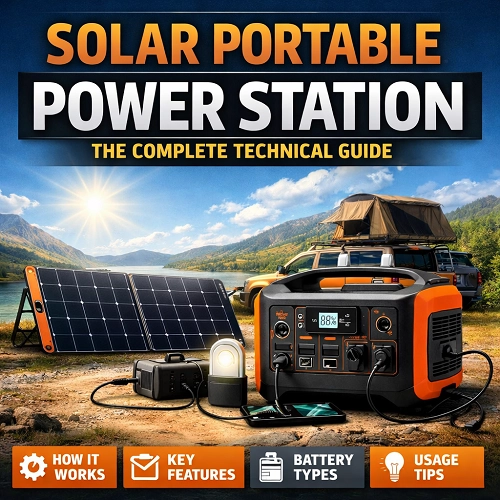
A solar portable power station is a self-contained energy storage device that combines a high-density battery pack, a multi-input charge controller, and a multi-output inverter/converter system into a single carry-anywhere enclosure. Unlike traditional fuel generators, solar power stations produce zero emissions, operate silently, and can be recharged from rooftop panels, car alternators, or standard wall outlets.
The global portable power station market is growing rapidly, driven by rising demand for outdoor recreation power, emergency backup solutions, and off-grid work sites. Manufacturers such as Zhejiang Sunohoo Technology Co., Ltd. — specialists in portable power station products, household energy storage systems, and industrial & commercial energy storage — are raising the bar with advanced battery chemistry and intelligent protection systems.
Key Insight: A solar portable power station differs from a standard power bank primarily in its ability to accept solar panel input and deliver both AC and DC output at meaningful wattages — making it capable of running appliances, not just charging phones.
Battery Chemistry: Why LiFePO4 Wins
The choice of battery chemistry is arguably the most consequential decision in power station design. While NMC (Nickel Manganese Cobalt) cells offer higher energy density, Lithium Iron Phosphate (LiFePO4 / LFP) chemistry has become the standard for stationary and semi-portable energy storage due to its superior safety profile and longevity.
LiFePO4 vs. NMC: A Technical Comparison
| Parameter | LiFePO4 (LFP) | NMC / NCA |
|---|---|---|
| Nominal cell voltage | 3.2 V | 3.6 – 3.7 V |
| Cycle life (to 80% capacity) | 4,000+ | 500 – 1,500 |
| Thermal runaway threshold | ~270 °C | ~150 – 210 °C |
| Energy density (gravimetric) | 90–160 Wh/kg | 150–260 Wh/kg |
| Self-discharge rate | ~2% / month | ~3–5% / month |
| Recommended use case | Safety-critical, high-cycle | High energy density priority |
| Cost trend (2025) | Declining rapidly | Volatile (cobalt price) |
Sunohoo Technology's HPQ0300E–HPQ0700E series is built on LiFePO4 cells rated for 4,000 charge-discharge cycles to 80% or more of original capacity. That translates to roughly 10+ years of daily use — far outlasting a typical NMC-based competitor. The company also employs accurate battery temperature control that keeps cell temperature 5 °C lower than mainstream alternatives, directly extending service life and reducing degradation.
Three Charging Methods Explained
A well-engineered solar power station accepts multiple energy sources so users are never stranded. Sunohoo's HPQ series supports three distinct charging paths, each with different input characteristics and ideal use scenarios.
| Charging Method | Input Voltage | Max Current / Power | Typical Charge Time | Best Use Case |
|---|---|---|---|---|
| AC Mains | 160–280 V AC, 50/60 Hz | 10 A max | ~1.3 hours | Home, office, campsite with shore power |
| Solar (PV) Input | 11–50 V DC | 13 A / 300 W max | ~2–5 h (varies by irradiance) | Off-grid, wilderness camping, rooftop |
| Car / 12 V DC | 12 V / 24 V DC | 8 A / 100 W max | ~5–6 h | Road trips, overlanding, emergency top-up |
The AC ultra-wide input range of 160–280 V is a noteworthy engineering decision. Most competitors limit AC input to 180–260 V; Sunohoo extends this to 160 V on the lower end, ensuring reliable operation in regions with unstable grid voltage — common in Southeast Asia, Africa, and parts of South America.
Solar input flexibility (11–50 V DC, up to 13 A) accommodates a wide range of panel configurations — from a single 100 W panel at 18 V open-circuit to a series string of higher-voltage panels — without requiring a separate MPPT charge controller.
Output Architecture: Powering Everything Simultaneously
Versatility in output determines practical usefulness. The HPQ series features 10 output ports covering every major consumer and professional device standard.
| Port Type | Qty | Output Specification | Max Power |
|---|---|---|---|
| AC Output (Pure Sine Wave) | ×2 | 230 V AC, 50/60 Hz | 300–700 W (model dependent) |
| AC Bypass Mode | ×2 | 220–240 V AC, 50/60 Hz | 1,495 W |
| USB-A Fast Charge | ×1 | 5 / 9 / 12 V @ 1.5 A (QC) | 18 W |
| USB-A Standard | ×2 | 5 V @ 2.4 A each, 3 A total | 15 W |
| USB-C (PD) | ×1 | 5/9/12/15 V @ 3 A; 20 V @ 5 A | 100 W |
| DC 12 V | ×2 | 12 V @ 3 A each | 36 W per port |
| Car Charging Port | ×1 | 12 V @ 10 A | 120 W |
| Wireless Charging Pad | ×1 | 5 / 7.5 / 10 / 15 W (Qi) | 15 W |
| LED Emergency Light | ×1 | 2 W, 3-level brightness | 2 W |
Pure Sine Wave AC Output is critical for sensitive electronics such as medical devices, variable-speed power tools, audio equipment, and CPAP machines. Modified sine wave inverters — found in cheaper units — can damage or reduce efficiency in these devices.
The bypass mode (up to 1,495 W) allows the unit to act as a transparent pass-through from the AC grid to connected devices when grid power is available, reserving battery capacity for outages. The seamless switching time of ≤20 ms is fast enough to be imperceptible to most sensitive electronics, including desktop computers and NAS drives.
8-Layer Safety Protection System
Safety is non-negotiable in lithium battery systems. A single protection failure can cause thermal runaway, fire, or equipment damage. Sunohoo's proprietary protection architecture implements eight independent safeguards operating in parallel:
- High Temperature Protection
- Low Temperature Protection
- Charging Overvoltage Protection
- Discharge Undervoltage Protection
- Charging Overcurrent Protection
- Discharge Overcurrent Protection
- Overload Protection
- Short Circuit Protection
From a systems design perspective, these protections operate at both the BMS (Battery Management System) level and the inverter/converter control loop level, providing hardware-level redundancy. The BMS continuously monitors individual cell voltages and temperatures at multiple points within the pack — not just at the aggregate terminals — enabling cell-level intervention before a fault propagates.
Operating Environment Limits
| Parameter | Specification | Notes |
|---|---|---|
| Charging temperature | 0 °C to 45 °C | Charging inhibited below 0 °C to prevent lithium plating |
| Discharging temperature | −10 °C to 45 °C | Reduced capacity at extremes |
| Storage temperature | −20 °C to 45 °C | Store at ~50% SoC for longevity |
| Humidity | 10% – 95% RH | Non-condensing |
| Altitude | < 2,000 m | Air cooling efficiency decreases at altitude |
| Protection class | IP20 | Indoor / sheltered outdoor use |
HPQ Series Model Comparison
The HPQ0300E through HPQ0700E family shares the same 512 Wh LiFePO4 battery and chassis but differs in AC output power — allowing buyers to select the right headroom for their load profile without paying for excess capacity.
| Model | Rated AC Output | Peak AC Output | AC Current | Ideal Loads |
|---|---|---|---|---|
| HPQ0300E | 300 W | 600 W | 1.3 A @ 230 V | Fans, LED lighting, smartphones, tablets |
| HPQ0400E | 400 W | 800 W | 1.8 A @ 230 V | Mini-fridge, CPAP, small power tools |
| HPQ0500E | 500 W | 1,000 W | 2.2 A @ 230 V | Portable AC unit, projector, laptop ×4 |
| HPQ0600E | 600 W | 1,200 W | 2.7 A @ 230 V | Coffee maker, blender, power drill |
| HPQ0700E | 700 W | 1,400 W | 3.1 A @ 230 V | Hair dryer (low), induction cooker (low) |
For heavier loads, Sunohoo offers expanded product lines including the HPQ0800E–HPQ1200E, the HPQ1300E–HPQ1800E, and the flagship HPQ2000E–HPQ3000E series — all under the same integrated energy storage ecosystem.
Engineering Highlights
Ultra-Wide AC Input
160–280 V AC acceptance range — 20 V wider than the industry mainstream — ensures reliable operation even on unstable grids.
Precision Thermal Management
Battery temperature kept 5 °C below mainstream products through active monitoring and airflow design, reducing long-term degradation.
Dimensionality-Upgrading Drive
Advanced load-adaptive inverter technology handles reactive loads (motors, compressors) with exceptional efficiency and stability.
Integrated LED Emergency Light
3-level brightness adjustment built directly into the unit — no separate flashlight needed during power outages.
Seamless UPS Function
≤20 ms switchover time from grid to battery — transparent to computers, NAS drives, and sensitive medical equipment.
Hidden Carry Handle
Flush-mount ergonomic handle reduces snagging and improves weight balance at 6.8 kg — genuinely portable for one person.
Certifications & Compliance
Regulatory compliance is mandatory for market access and demonstrates that a product has been independently verified to meet safety and electromagnetic standards. The HPQ series carries the following certifications:
UN38.3 certification is particularly significant — it is the international transport safety standard for lithium batteries required by airlines, shipping carriers, and logistics providers. Products without this certification cannot be legally transported by air. RoHS compliance confirms the unit is free of restricted hazardous substances including lead, mercury, and hexavalent chromium. Learn more about Sunohoo's compliance framework on the Certification page.
Real-World Application Scenarios
The application scope of a solar portable power station spans recreational, professional, and emergency domains:
| Scenario | Key Loads | Typical Draw | Recommended Model |
|---|---|---|---|
| Weekend Camping | LED lights, phone charging, portable speaker, small fan | 50–120 W | HPQ0300E |
| Van / Overlanding | 12 V fridge, USB devices, dashcam, laptop | 80–200 W | HPQ0400E |
| Home Emergency Backup | Router, NAS, CPAP, some LED lighting | 100–300 W | HPQ0500E |
| Remote Worksite | Laptop ×2, drill charger, LED work light | 200–450 W | HPQ0600E |
| Digital Entertainment | Projector, gaming console, soundbar, streaming device | 250–550 W | HPQ0700E |
Maintenance & Long-Term Care
LiFePO4 chemistry is inherently lower-maintenance than other lithium types, but following a few practices maximizes longevity over the full 4,000-cycle rated life:
| Task | Frequency | Importance |
|---|---|---|
| Wipe unit with soft dry cloth | After each trip | Routine |
| Clean solar panel surface | Weekly during extended use | Routine |
| Recharge to 50–80% SoC if storing | Before every storage period | Important |
| Full charge–discharge cycle if idle | Every 3 months | Important |
| Check port contacts for oxidation | Annually | Routine |
| Firmware update check (if applicable) | Annually | Routine |
About Zhejiang Sunohoo Technology Co., Ltd.
Headquartered in Zhejiang, China, Zhejiang Sunohoo Technology Co., Ltd. is a manufacturer and developer of energy storage solutions spanning portable, residential, and commercial scales. The company maintains strong R&D capabilities and collaborates with universities to push forward next-generation battery management and power electronics. Sunohoo's product ecosystem covers:
- Portable Power Station Products
- Household Energy Storage System Products
- Energy Storage Battery System Products
- Industrial & Commercial Energy Storage Systems
For technical inquiries, pricing, and customization requests, visit the Get a Quote page or reach the team directly at sunohoo_hn@sunorensolar.com / +86-573-87393188.


