


The global push toward carbon neutrality, paired with rising electricity tariffs and increasingly unpredictable grid conditions, has made the Industrial & Commercial Energy Storage System one of the most strategically important investments a facility manager can make. Unlike residential battery packs, industrial-grade systems must handle sustained high-power loads, comply with stringent safety certifications, and integrate seamlessly with existing SCADA or EMS platforms.
What Is an Industrial Energy Storage System?
An Industrial Energy Storage System (IESS) is an integrated assembly of battery modules, power conversion hardware, and intelligent control software designed to store electrical energy at scale and dispatch it on demand. In a commercial or industrial (C&I) context, these systems typically operate in the range of tens of kilowatts to several megawatts, bridging the gap between utility-scale grid storage and small residential units.
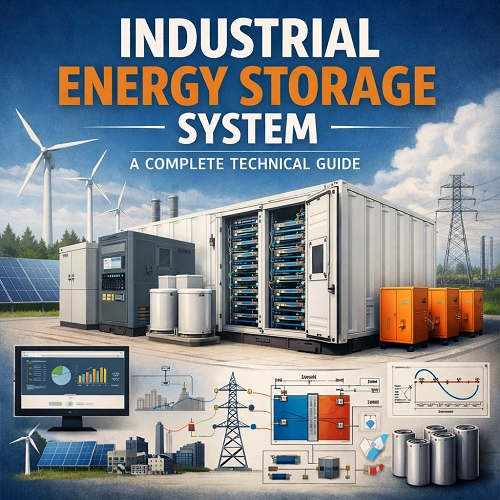
A modern IESS bundles at minimum four subsystems into a single engineered solution:
High-capacity lithium iron phosphate cells providing up to 6,000 charge–discharge cycles with minimal capacity fade.
Monitors cell voltage, temperature, state of charge, and state of health in real time to protect and optimize the pack.
Bidirectional inverter-charger that converts DC from the battery to AC for loads, and AC from the grid or generator to DC for charging.
Cloud or on-premise software layer that schedules charge/discharge cycles, implements peak shaving logic, and logs performance data.
Core Technology: LiFePO₄ Battery Chemistry
The choice of battery chemistry is the single most consequential specification decision in any industrial energy storage project. Lithium Iron Phosphate (LiFePO₄) has become the dominant chemistry for C&I applications for several compelling reasons.
| Parameter | LiFePO₄ (LFP) | NMC (Lithium Nickel Manganese Cobalt) | Lead-Acid (VRLA) |
|---|---|---|---|
| Cycle Life | 4,000 – 6,000+ cycles | 1,500 – 3,000 cycles | 500 – 1,200 cycles |
| Thermal Runaway Risk | Very low | Moderate | Low |
| Energy Density | 90 – 160 Wh/kg | 150 – 250 Wh/kg | 30 – 50 Wh/kg |
| Operating Temperature | −20 °C to +60 °C | −20 °C to +55 °C | −15 °C to +40 °C |
| Depth of Discharge (DoD) | Up to 95 % | Up to 90 % | 50 – 60 % |
| Maintenance | None | Minimal | Periodic watering / equalization |
| Typical 10-yr TCO | Lowest | Medium | Highest (replacements) |
Sunohoo's industrial systems are built around LiFePO₄ cells that deliver up to 6,000 charge/discharge cycles with less than 20% capacity degradation — roughly 16 years of daily cycling at a 0.5C rate. This durability translates directly into a lower levelized cost of storage (LCOS) compared to any competing chemistry.
Battery Management System (BMS) Architecture
A sophisticated BMS is what separates a professional industrial energy storage system from a simple battery bank. The BMS in Sunohoo's systems performs multi-layer protection and optimization:
| BMS Function | Description | Industrial Benefit |
|---|---|---|
| Cell Voltage Monitoring | Tracks each cell to ±5 mV accuracy | Prevents over-charge / deep discharge |
| Active / Passive Balancing | Equalizes cell states of charge | Extends pack life by 15–30% |
| Thermal Management | Temperature sensors + cooling control | Maintains optimal 20–35 °C operating range |
| State of Health (SOH) | Estimates remaining capacity vs. nominal | Enables predictive maintenance scheduling |
| Fault Isolation | Disconnects faulty modules automatically | Prevents cascade failure; system stays online |
| CAN / RS-485 / Modbus | Industry-standard communication protocols | Easy SCADA and EMS integration |
Key Operational Strategies
Peak Shaving
Electricity tariffs for commercial and industrial customers typically include a demand charge — a monthly fee based on the peak 15- or 30-minute average power draw. By pre-charging the battery during off-peak hours and discharging during demand peaks, an IESS can cap the facility's grid draw and eliminate expensive demand spikes. Savings of 20–40% on monthly electricity bills are common for facilities with volatile load profiles.
Load Shifting (Time-of-Use Arbitrage)
Where time-of-use (TOU) tariffs apply, the system charges when grid electricity is cheap (typically overnight) and discharges when rates are high (typically afternoon and evening). The EMS calculates the optimal charge/discharge schedule daily, factoring in forecast solar generation, weather, and historical consumption patterns.
Backup Power & Uninterruptible Supply
In the event of a grid outage, the PCS transitions seamlessly to island mode — typically in under 20 milliseconds — maintaining power to critical loads. This capability is invaluable for data centers, hospitals, cold-chain logistics, and any process where even a brief interruption causes significant financial loss.
Solar Self-Consumption Optimization
When paired with rooftop or ground-mount photovoltaic arrays, the IESS stores excess solar generation that would otherwise be exported to the grid at low feed-in tariff rates, then delivers it to the facility's loads when solar output falls short. Sunohoo's Three-phase Hybrid Solar Inverter (8.5 kW–30.5 kW) and larger variants are purpose-built for this use case.
System Architecture & Integration
A complete industrial energy storage installation involves several layers that must be coordinated at the engineering design stage:
| Layer | Components | Key Integration Points |
|---|---|---|
| Generation | PV array, diesel genset, grid connection | DC bus, AC coupling point |
| Storage | LiFePO₄ battery cabinets, BMS | DC bus voltage, BMS CAN bus |
| Conversion | PCS / Hybrid Inverter | Grid relay, anti-islanding protection |
| Distribution | Switchgear, circuit breakers, meters | Facility MV/LV panel, smart meters |
| Control | EMS (on-prem or cloud), HMI | Modbus TCP, IEC 61850, SCADA/DCS |
| Monitoring | Mobile app, web dashboard, alerts | API, MQTT, remote firmware updates |
Sunohoo's systems support plug-and-play installation with simplified wiring and pre-configured communication parameters, significantly reducing commissioning time and the associated labor costs. Learn more on the Technology page, which details the company's R&D capabilities, university cooperation programs, and advanced workshop equipment.
Target Applications & Use Cases
| Sector | Primary Use Case | Typical System Size | Key Driver |
|---|---|---|---|
| Manufacturing Plants | Peak shaving, backup power | 200 kWh – 5 MWh | Demand charge reduction |
| Commercial Buildings | TOU arbitrage, solar self-consumption | 50 kWh – 500 kWh | Electricity bill savings |
| Data Centers | UPS replacement, demand response | 500 kWh – 10 MWh | Uptime & power quality |
| Cold Chain / Logistics | Backup power for refrigeration | 100 kWh – 1 MWh | Regulatory compliance |
| Remote / Off-grid Sites | Hybrid solar-storage microgrid | 50 kWh – 2 MWh | Grid independence |
| EV Charging Hubs | Buffer storage for fast chargers | 200 kWh – 2 MWh | Grid capacity constraint |
Certifications & Quality Assurance
Industrial energy storage systems are subject to stringent safety, grid-connection, and electromagnetic compliance standards. Sunohoo — recognized as a National High-Tech Enterprise since 2011 — designs its products to meet the most widely required international certifications. Prospective buyers should verify certification scope with the official certification documentation before specifying any project.
| Standard / Certification | Scope | Relevant Market |
|---|---|---|
| IEC 62619 | Safety requirements for secondary lithium cells in industrial applications | Global |
| UL 9540 / UL 9540A | Standard for energy storage systems and equipment; fire propagation | North America |
| CE (LVD + EMC) | Low Voltage Directive & electromagnetic compatibility | European Union |
| IEC 62477 / IEC 61850 | Power electronic converter safety; substation communication | Global |
| ISO 9001 | Quality management system for design and manufacturing | Global |
Conclusion
Industrial energy storage is no longer a niche technology — it is becoming a fundamental component of energy infrastructure for any facility that values cost control, operational resilience, and sustainability. The convergence of mature LiFePO₄ chemistry, high-efficiency bidirectional PCS hardware, and cloud-connected EMS software has made deploying a reliable C&I system more straightforward than ever.
Zhejiang Sunohoo Technology Co., Ltd brings over 15 years of energy storage R&D experience, a vertically integrated product portfolio, and demonstrated commitment to international quality standards. Whether you are evaluating your first peak-shaving installation or planning a multi-site microgrid rollout, the Industrial & Commercial Energy Storage System line and the broader Sunohoo ecosystem offer a technically sound starting point.
For project-specific sizing, technical datasheets, or pricing, visit the Get a Quote page or explore the FAQ section for common installation and integration questions.


