


What Is a Home Solar Power System?
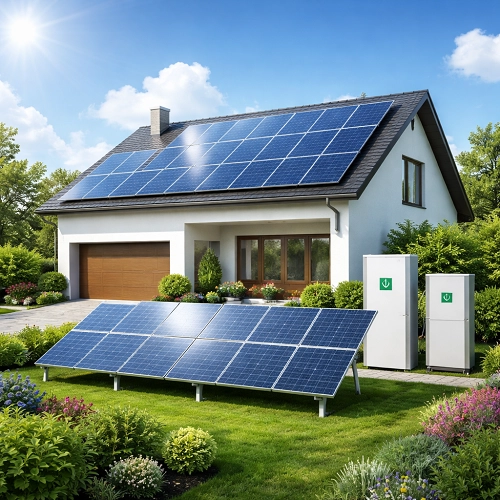
A home solar power system combines photovoltaic (PV) solar panels, a battery energy storage unit, a charge controller, and an inverter to capture sunlight and convert it into clean, usable electricity for your household. Unlike grid-tied-only setups, a system with a dedicated battery bank lets you store surplus daytime energy and draw on it during evening hours, cloudy days, or grid outages.
Modern all-in-one portable power stations — such as the Sunohoo HPQ Series — package every key component into a compact, carry-anywhere unit, making solar self-sufficiency accessible for apartments, cabins, RVs, and conventional homes alike.
Key insight: The International Energy Agency (IEA) reports that rooftop and small-scale solar capacity is growing faster than any other electricity source globally, driven by falling battery costs and rising grid-electricity prices. A quality home solar power system now pays for itself in 4–7 years on average.
How a Home Solar Power System Works
Understanding the energy flow is the first step to sizing and operating your system correctly. A residential solar-storage setup follows a straightforward four-stage cycle:
1. Solar Generation (PV Input)
Solar panels convert photons from sunlight into direct current (DC) electricity. The Sunohoo HPQ Series accepts a wide PV input range of 11 V – 50 V DC at up to 15 A / 400 W, accommodating a wide variety of panel configurations without requiring an external charge controller.
2. Charge Management
An internal maximum power point tracking (MPPT) circuit maximises energy extraction from the panels across varying light conditions. The unit also supports AC mains charging (220–240 V AC, 10 A max) and 12 V / 24 V vehicle charging, giving three independent input paths so you are never stranded without power.
3. Energy Storage (LiFePO4 Battery)
Harvested energy is stored in a Lithium Iron Phosphate (LiFePO4) cell pack. This chemistry is preferred for home applications because of its inherently stable crystal structure, which resists thermal runaway — the overheating chain reaction that can cause fires in older lithium-ion designs.
4. Power Delivery (AC & DC Output)
When you need power, the system's pure sine wave inverter converts stored DC back to clean 230 V AC — compatible with sensitive electronics, variable-speed motors, and medical equipment. Simultaneously, multiple DC rails deliver 5 V USB, 12 V regulated, and wireless charging power to smaller devices.
LiFePO4 Battery Technology Explained
The battery is the heart of any household energy storage system. Choosing the right chemistry dramatically affects safety, lifespan, and total cost of ownership.
| Parameter | LiFePO4 (Used by Sunohoo) | NMC Li-ion | Lead-Acid |
|---|---|---|---|
| Cycle Life | 3,000+ cycles | 500 – 1,000 cycles | 300 – 500 cycles |
| Thermal Stability | Excellent | Moderate | Good |
| Energy Density | ~120–160 Wh/kg | ~150–220 Wh/kg | ~30–50 Wh/kg |
| Self-Discharge / Month | ~2 % | ~2–3 % | ~5–15 % |
| Depth of Discharge | Up to 100 % | Up to 80–90 % | Up to 50 % |
| Maintenance | None required | None required | Periodic topping up |
| Toxicity | Low (RoHS compliant) | Moderate | High (lead) |
Sunohoo's LiFePO4 packs are lab-tested to retain more than 80 % of their rated capacity after 3,000 full charge-discharge cycles at 25 °C — translating to more than 8 years of daily cycling before any noticeable performance decline. The battery temperature is managed to run 5 °C cooler than mainstream competitors, extending cell longevity further.
Certifications: Sunohoo's home solar power system batteries carry CE, SAA, RoHS, UN38.3, and MSDS certifications, meeting European, Australian, and international transport safety standards.
Full Technical Specifications — HPQ Series
The table below covers the HPQ0800E–HPQ1200E portable power station lineup, Sunohoo's flagship home solar power system range.
| Specification | HPQ0800E | HPQ1000E | HPQ1200E |
|---|---|---|---|
| Battery Capacity | 768 Wh (LiFePO4) | ||
| AC Output (×2) | 230 V AC, 800 W (peak 1,600 W) | 230 V AC, 1,000 W (peak 2,000 W) | 230 V AC, 1,200 W (peak 2,400 W) |
| AC Input Voltage | 160 – 280 V AC (ultra-wide; industry standard is 180 – 260 V) | ||
| AC Charge Time | ≈ 1.3 hours | ||
| Solar (PV) Input | 11 – 50 V DC, max 15 A / 400 W | ||
| Car Charging Input | 12 V / 24 V DC, max 8 A / 100 W | ||
| USB-A Fast Charge (×1) | 5 / 9 / 12 V DC, 1.5 A — 18 W max | ||
| USB-A Standard (×2) | 5 V DC, 2.4 A — 12 W max | ||
| USB-C (×1) | 5 / 9 / 12 / 15 V DC, 3 A; 20 V DC, 5 A — 100 W max | ||
| DC 12 V Output (×2) | 12 V DC, 3 A — 36 W per port | ||
| Car Port Output | 12 V DC, 10 A — 120 W max | ||
| Wireless Charging | 5 W / 7.5 W / 10 W / 15 W Qi | ||
| LED Emergency Light | 2 W, 3-level brightness | ||
| Switching Time (UPS) | ≤ 20 ms | ||
| Dimensions (W×D×H mm) | 336 × 218 × 203 | ||
| Weight | 9.8 kg | ||
| Operating Temp (Charge) | 0 °C – 40 °C | ||
| Operating Temp (Discharge) | −10 °C – 40 °C | ||
| Storage Temperature | −20 °C – 45 °C | ||
| Humidity | 10 – 95 % (non-condensing) | ||
| Altitude | < 2,000 m | ||
| Protection Class | IP20 | ||
Specifications are subject to change without notice. Always refer to the official Sunohoo product page for the latest data.
8-Layer Safety Protection System
Safety is non-negotiable in any energy storage application. Sunohoo's home solar power system employs eight independent hardware and firmware protection layers to guard against every foreseeable fault condition:
| # | Protection Type | What It Prevents | Status |
|---|---|---|---|
| 1 | High-Temperature Protection | Cell damage and fire risk from overheating | Active |
| 2 | Low-Temperature Protection | Lithium plating during cold-weather charging | Active |
| 3 | Charging Over-Voltage Protection | Cell stress and capacity degradation | Active |
| 4 | Discharge Under-Voltage Protection | Deep-discharge cell damage | Active |
| 5 | Charging Over-Current Protection | Wiring and connector damage during fast charge | Active |
| 6 | Discharge Over-Current Protection | Tripping from sudden high-load demands | Active |
| 7 | Overload Protection | Output damage when total load exceeds rated power | Active |
| 8 | Short-Circuit Protection | Catastrophic current surge from wiring faults | Active |
Three Charging Methods for Every Situation
Versatile input options mean your home solar power system is never without an energy source, whether you are at home, in transit, or off-grid.
| Charging Method | Input Specification | Typical Charge Time | Best Use Case |
|---|---|---|---|
| AC Mains | 220 – 240 V AC, 10 A max | ≈ 1.3 hours | Fastest; everyday home top-up |
| Solar PV | 11 – 50 V DC, 400 W max | 2 – 5 hours (sunshine dependent) | Off-grid; zero-cost green energy |
| Vehicle (12 V / 24 V) | 12 / 24 V DC, 8 A / 100 W max | 8 – 10 hours | Road trips; emergency top-up |
The AC input voltage range of 160 – 280 V AC is notably wider than the industry-standard 180 – 260 V range, giving the unit resilience against unstable grid voltages common in rural areas or developing markets.
Applications of a Home Solar Power System
From everyday household backup to outdoor adventure, the Sunohoo HPQ Series covers a broad spectrum of real-world use cases. Browse Sunohoo's full application pages for scenario-specific guidance.
- Home Backup Power: Keep fridges, fans, Wi-Fi routers, and lighting running during grid outages. The ≤20 ms switching time means most electronics never even notice the transition.
- Solar Self-Consumption: Pair with rooftop panels to store midday surplus and use it in the evening, reducing your electricity bill and carbon footprint.
- Outdoor Recreation: Camping, glamping, and tailgating are all easier with a compact 9.8 kg unit that powers kettles, laptops, cameras, and portable speakers simultaneously.
- Remote Work & Digital Nomads: Power monitors, laptops, phones, and lighting from a single portable hub — no generator noise, no fumes.
- Emergency Preparedness: Storms, earthquakes, and utility disruptions are unpredictable. A charged home solar power system provides days of essential power for medical devices, communications, and food preservation.
- Construction & Field Work: Cordless tool charging, site lighting, and CCTV cameras can run from a silent battery station where grid power is unavailable.
Maintenance & Best Practices
LiFePO4 batteries are exceptionally low-maintenance compared to lead-acid alternatives, but a few simple habits will maximize the life of your system. Visit the Sunohoo FAQ for additional guidance.
| Practice | Frequency | Why It Matters |
|---|---|---|
| Wipe unit and panels with a dry soft cloth | Monthly | Dust on panels reduces harvest by up to 25 %; dust on vents restricts cooling |
| Perform a full charge cycle | Every 3 months if unused | Prevents cell imbalance and self-discharge losses during long storage |
| Store in a cool, dry location | Always when not in use | High ambient temperature is the primary accelerator of battery aging |
| Avoid sustained 100 % or 0 % state of charge | Ongoing | Keeping SoC between 20 – 80 % during long-term storage extends cycle life |
| Do not exceed rated load | Every use | Overloading triggers protective shutdown and stresses output electronics |
| Inspect cables and connectors | Every 6 months | Loose or corroded connections waste energy and are a potential fire hazard |
About Zhejiang Sunohoo Technology Co., Ltd.
Zhejiang Sunohoo Technology Co., Ltd. is a China-based manufacturer specialising in portable power stations and residential energy storage systems. The company's product portfolio spans four major categories:
- Portable Power Station Products — compact, carry-anywhere units from 300 Wh to 5,500 Wh
- Household Energy Storage Systems — wall-mounted and stacked battery banks for whole-home backup
- Energy Storage Battery Systems — modular rack-mount solutions for flexible capacity scaling
- Industrial & Commercial Energy Storage — high-capacity systems for commercial peak shaving and demand-response
The company maintains in-house R&D capabilities and collaborates with leading universities to advance battery management system (BMS) algorithms and thermal control technology. Learn more on the Technology page.
Contact Sunohoo:+86-573-87393188 ;| sunohoo_hn@sunorensolar.com | sunohootech.com
How to Choose the Right Home Solar Power System
Selecting a system starts with calculating your daily energy needs. Use the table below as a quick reference for common household loads:
| Appliance | Typical Power (W) | Daily Run Time | Daily Energy (Wh) |
|---|---|---|---|
| LED Lighting (×5 bulbs) | 40 | 6 h | 240 |
| Laptop | 60 | 8 h | 480 |
| Wi-Fi Router | 10 | 24 h | 240 |
| Smartphone Charging (×4) | 25 | 2 h | 50 |
| Small Refrigerator | 80 | 12 h (compressor cycles) | 960 |
| Fan (desk) | 35 | 8 h | 280 |
| Total | — | — | 2,250 Wh / day |
For the 768 Wh HPQ series, this load profile would require roughly 3 units or supplemental solar charging throughout the day — a realistic scenario for an off-grid cabin. For whole-home backup, explore Sunohoo's Household Energy Storage System Products, which offer higher capacity wall-mount installations.
Key selection criteria at a glance:
- Capacity (Wh): Match to your daily load × desired days of autonomy
- Peak Output (W): Must exceed the startup surge of your largest motor-driven appliance
- Input Options: Solar + AC + car charging maximises resilience
- Battery Chemistry: Choose LiFePO4 for safety, lifespan, and low maintenance
- Certifications: CE, SAA, UN38.3, and RoHS confirm regulatory compliance for your market
- Portability: If mobility matters, factor in weight and handle design
Ready to Go Solar at Home?
Explore the full Sunohoo range or reach out to the team for a personalised energy-storage recommendation tailored to your home and budget.
Get a Free Quote View All Products


