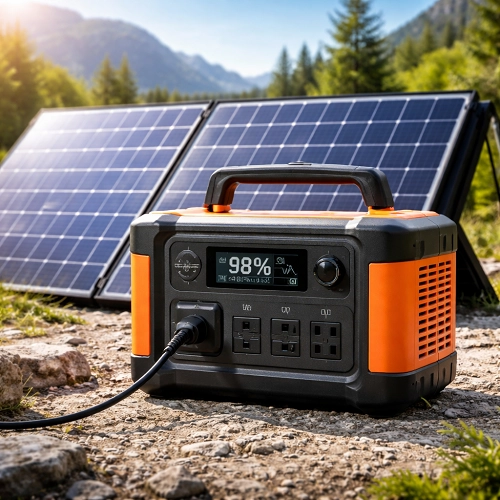
Portable solar power stations are rapidly becoming essential tools for outdoor enthusiasts, emergency preppers, and anyone seeking reliable, clean energy wherever they go. Combining advanced battery technology, flexible charging options (including solar input), and versatile output ports, these devices bring portable power to a wide range of use cases — from camping trips to home backup during outages.
What Is a Solar Portable Power Station?
A solar portable power station is essentially a compact, rechargeable energy storage system that provides electricity on demand. It pairs with solar panels (sold separately in many cases) to harvest energy from sunlight, convert it into stored electrical power, and deliver it to devices via AC outlets, USB ports, and DC outputs. It’s like a super‑sized, highly advanced power bank that can run everything from phones to refrigerators — depending on its capacity.
Technically, these systems resemble solar generators, but the term “portable power station” has become more widely used because it better reflects the underlying technology and versatility of modern devices.
How Solar Portable Power Stations Work
At the heart of every solar portable power station are four core components:
1. Battery Pack
This stores electrical energy. Capacities are measured in watt‑hours (Wh) — the higher the number, the more energy you can store and use. For example, a 1,000 Wh station can theoretically power a 100 W device for about 10 hours.
Battery chemistries matter:
- Lithium Iron Phosphate (LiFePO₄ / LFP) — longer lifespan (2,000–4,000+ cycles), higher thermal stability, safer overall.
- Lithium‑ion (NMC) — lighter and less expensive, but shorter cycle life (~500–1,000 cycles).
2. Inverter
Converts stored DC (direct current) power into AC (alternating current) usable by devices like laptops, refrigerators, and power tools. Quality stations use pure sine wave inverters to safely power sensitive electronics.
3. Charge Controller
Manages incoming energy from solar panels (and wall/car charging). Most modern units use MPPT (Maximum Power Point Tracking) controllers to optimize solar charging efficiency, often improving performance up to 30 % compared to simpler PWM controllers.
4. Output Ports
These deliver usable electricity:
- AC outlets — for appliances
- USB‑A / USB‑C — for phones, tablets, laptops
- 12 V DC / car ports — for coolers, pumps, etc.
Charging Methods
Solar portable power stations can be charged in three main ways:
- Solar Panels: Clean and off‑grid, the speed depends on panel wattage and sunlight conditions.
- Wall AC Outlet: Fastest method when grid power is available.
- Car DC Outlet: Useful on road trips or in RVs, but slower than other methods.
Solar input capacity (measured in watts) and panel open‑circuit voltage (Voc) must match the station’s limits to charge safely and efficiently.
Solar Portable Power Station vs. Gas Generators
Traditional gas generators are powerful and fuel‑based, but they come with noise, emissions, and maintenance downsides. Solar portable power stations offer:
- Clean, quiet energy
- No fuel costs
- Portable, often lighter designs
- Allowed in many locations where gas generators are restricted
- Safe indoor use (no exhaust)
However, solar stations can be limited by battery capacity and recharge speed — especially in low sunlight — and usually don’t produce continuous power for high‑draw appliances as long as a gas unit might without refueling.
Key Features to Consider
When comparing solar portable power stations, keep these in mind:
Capacity (Wh)
Higher Wh means longer runtime and the ability to power larger devices. For example, a 2,000 Wh station can run a refrigerator far longer than a 300 Wh unit.
Power Output (Watts)
Continuous power tells you what loads the station can support. Higher wattage is important for tools or full‑size appliances.
Battery Longevity
LiFePO₄ batteries provide thousands of cycles, far outliving typical lithium‑ion packs.
Port Selection
More ports means ability to power multiple devices simultaneously — ideal for camping or work sites.
Expandability
Some larger systems allow additional batteries or panel arrays for scalable power.
Solar portable power stations are a versatile and rapidly advancing category bridging the gap between small power banks and traditional generators. Whether used for outdoor adventures, emergency backup, or off‑grid living, today’s models offer a range of capacities, features, and price points to fit different needs.