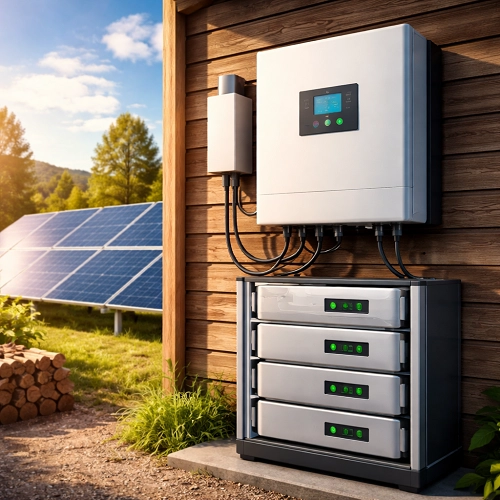
Off-grid solar energy systems operate independently of the utility grid. They harness solar photovoltaic (PV) energy, store it in batteries, and deliver usable AC power to loads. A central component enabling this functionality is the energy storage inverter (often called an off-grid inverter or PV inverter with storage). These inverters must perform multiple roles: DC to AC conversion, energy management, battery charging, grid-forming, and system protection.
Fundamental Concepts
Roles of an Off-Grid Inverter
An off-grid solar inverter must:
- Convert DC to AC: Convert battery DC power to AC power for appliances (typically 120/240 VAC, 50/60 Hz).
- Manage Battery Charging: Regulate charge current from solar and auxiliary sources to battery.
- Perform MPPT: Maximize PV array output via Maximum Power Point Tracking (MPPT).
- Provide Grid-Forming Functionality: Establish stable AC voltage and frequency without external reference.
- Handle Multiple Power Sources: Integrate PV, generators, and possibly wind/other renewables.
- Protect System and Loads: Overload, short-circuit, ground fault, over/under voltage, and thermal protection.
Key Electrical Domains
| Domain | Typical Voltage |
| PV Array DC | 100–600 VDC (higher in larger systems) |
| Battery Bank DC | 12–24–48–120–400 VDC |
| AC Output | 120/240 VAC (single phase), 208/240/480 VAC (three phase) |
Core Components and Architecture
Power Stage
The inverter power stage comprises:
- DC–DC converter: Interfaces PV array to battery/inverter DC bus; performs MPPT.
- Battery Charge Controller: Controls charge current and voltage to batteries; supports charge stages (bulk, absorption, float).
- DC Link / Bus: Intermediate energy buffer (capacitors/inductors).
- Inverter Bridge: Converts DC to AC using switching transistors (IGBTs, MOSFETs).
- AC Filter and Transformer: Smooths PWM output; provides isolation and voltage transformation.
Digital Control and Protection
Modern inverters use DSP/FMCU controllers for:
- MPPT algorithms (e.g., Perturb & Observe, Incremental Conductance)
- PWM generation and modulation
- Protection logic (overcurrent, overtemp, ground fault)
- Communications (CAN, Modbus, Ethernet)
Energy Management Unit (EMU)
An EMU coordinates:
- Priority of energy sources (solar vs battery vs generator)
- Load shedding
- State of Charge (SoC) estimation
- Time-of-use and demand scheduling (in hybrid systems)
Inverter Topologies
Stand-Alone Voltage Source Inverter (VSI)
- Produces AC voltage/frequency independently.
- Requires robust control to maintain frequency and voltage under load changes.
Multi-Mode or Hybrid Inverter
Integrates PV inverter + charge controller + battery inverter in one:
- Seamless switching between modes (charging, discharging, standby).
- Often includes generator support.
Split Phase & Three-Phase Systems
- Split Phase: Offers 120/240 VAC for North American homes.
- Three-Phase: Used in commercial/off-grid microgrids requiring balanced loads.
Battery Integration and Charging
Battery Chemistries
Inverters must support a range of batteries:
- Lead-Acid (Flooded, AGM, GEL)
- Lithium-Ion (LiFePO₄, NMC)
- Flow Batteries
Each chemistry has unique voltage profiles, charge limits, and safety needs.
Charge Control
Effective charging requires multi-stage control:
- Bulk: Max current until voltage threshold.
- Absorption: Holds voltage to complete charge.
- Float: Maintains full charge at low current.
- Equalization (lead-acid specific): Periodic voltage boost for cell balancing.
Maximum Power Point Tracking (MPPT)
MPPT maximizes energy harvested from PV modules. Two common algorithm families:
| Algorithm | Strengths | Drawbacks |
| Perturb & Observe | Simple, widely used | Can oscillate around MPP |
| Incremental Conductance | Better in rapidly changing conditions | More computationally involved |
MPPT Implementation
An MPPT controller adjusts the duty cycle of a DC–DC converter to track the operating point where .
Control Strategies and Grid-Forming
Frequency and Voltage Control
Off-grid inverters generate and regulate:
- Frequency via real-time control loops
- Voltage amplitude and waveform quality (sinusoid fidelity, total harmonic distortion)
Virtual Inertia and Droop Control
To mimic grid behavior and stabilize microgrids:
- Droop control: Shares load among parallel inverters without a central controller.
- Virtual inertia: Helps stabilize frequency in high-renewable systems.
Performance Metrics
| Metric | Importance |
| Efficiency | High efficiency reduces losses; target > 95% for modern systems |
| Total Harmonic Distortion (THD) | Low THD (<5%) ensures compatibility with sensitive loads |
| Power Factor | Unity or adjustable power factor improves load handling |
| Response Time | Fast transient response mitigates voltage/frequency excursions |
Thermal and Reliability Considerations
Heat Dissipation
- Heat sinks, forced air cooling, and liquid cooling in large systems.
- Thermal sensors with dynamic derating prevent overheating.
Component Lifetime
- Capacitor lifetime at elevated temperatures (Arrhenius effect)
- Transistor switching reliability
Protection and Safety
Electrical Protections
- Overcurrent and short-circuit protection
- Overvoltage/undervoltage lockout
- Ground fault detection
- Anti-islanding (even off-grid inverters prevent inadvertent islanding if briefly connected)
Safety Standards
- UL 1741 / IEEE 1547 (inverters and interconnection)
- NEC Article 690 & 705 (PV system installation)
- IEC 62109 (inverter safety)
Common Technical Issues and Solutions
| Issue | Cause | Mitigation |
| MPPT hunting | Rapid irradiance change | Adaptive MPPT algorithms |
| Battery degradation | Overcharge/overdischarge | Accurate SoC algorithms and BMS |
| Voltage instability | Sudden load change | Fast control loops, virtual inertia |
| High THD | Poor switching design | Better filters, advanced PWM |
| Thermal shutdown | Insufficient cooling | Enhanced heat dissipation |
System Sizing and Design
Load Analysis
- Peak vs continuous loads
- Surge requirements (motors, compressors)
PV Array Sizing
Depends on:
- Daily energy demand
- Solar irradiance profile
- Battery autonomy requirement
Battery Bank Sizing
Calculated by:
Integration with Other Sources
Off-grid inverters often integrate:
- Wind turbines
- Diesel/propane generators
- Hydro turbines
Controllers must manage source prioritization, synchronization (if variable AC gensets), and seamless transfer.
Monitoring, Diagnostics, and Communications
Modern inverters offer:
- Real-time monitoring (SoC, PV input, AC output)
- Remote diagnostics via IoT
- Firmware updates
Protocols: Modbus, CAN, RS-485, Ethernet, MQTT
Future Directions
Emerging advances in off-grid inverters include:
- AI/ML for predictive energy management
- Solid-state transformers
- Bidirectional EV chargers as grid/in-home storage resources
- Enhanced microgrid interoperability standards
Off-grid solar energy storage inverters are sophisticated, multifunctional power electronic systems. They must integrate PV harvesting, energy storage, power conversion, control intelligence, and safety protections to provide reliable, high-quality AC power in stand-alone applications. Understanding their architecture, control strategies, and common technical issues enables better design, deployment, and long-term operation in both residential and commercial off-grid systems.