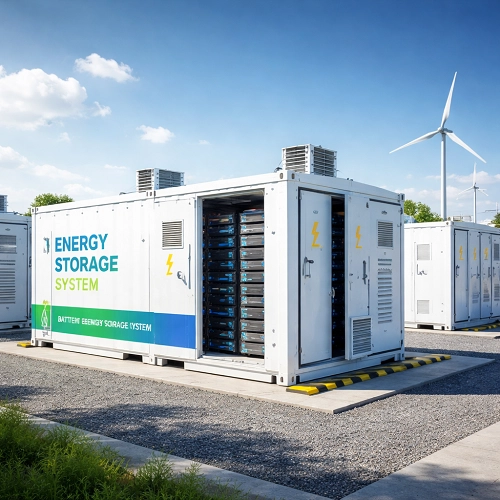
Energy storage battery systems are rapidly becoming foundational to modern power infrastructure — enabling grid stability, renewable energy integration, electrified transportation, and resilient backup power.
1. Introduction to Battery Energy Storage Systems (BESS)
Battery energy storage systems store electrical energy in chemical form and release it when needed. Unlike flywheels or pumped hydro, batteries offer high energy density, modular deployment, and fast response times — making them extremely versatile across residential, commercial, and utility-scale applications.
Modern BESS can:
- Shift energy consumption to off-peak times
- Smooth renewable generation variability
- Provide frequency and voltage support
- Backup critical infrastructure during outages
2. Key Battery Technologies
Lithium-Ion (Li-ion)
Li-ion technology dominates the market due to high energy density, efficiency, and decreasing costs.
Chemistries include:
- NMC (Nickel Manganese Cobalt) – Balanced energy & power
- LFP (Lithium Iron Phosphate) – Enhanced safety & longevity
- NCA (Nickel Cobalt Aluminum) – High energy density (e.g., EVs)
Pros:
- High round-trip efficiency (>90%)
- Fast charge/discharge capabilities
Cons:
- Thermal management required
- Raw material cost volatility
Flow Batteries
Flow batteries (e.g., vanadium redox) store energy in liquid electrolytes separated by membranes.
Pros:
- Scalable capacity by increasing electrolyte volume
- Long cycle life (typically >10,000 cycles)
Cons:
- Lower energy density
- Complex auxiliary systems
Lead-Acid
An older but still relevant chemistry for stationary backup due to low cost and established manufacturing.
Pros:
- Cost-effective initially
- Robust
Cons:
- Shorter life and depth-of-discharge limits
- Lower efficiency (~70–85%)
Other Technologies
- Solid-State Batteries: Promising higher safety & energy density
- Sodium-Ion: Potential low-cost alternative to Li-ion
- Nickel-Metal Hydride (NiMH): Used in hybrid vehicles; limited grid usage
3. System Architecture and Components
A complete BESS comprises:
1. Battery Modules & Racks
Cells assembled into modules and interconnected into racks for desired voltage and capacity.
2. Battery Management System (BMS)
Monitors cell voltage, temperature, and state-of-charge (SoC). Ensures balancing and prevents overcharge, deep discharge, overheating, or short circuits.
3. Power Conversion System (PCS)
Bidirectional inverters convert DC (battery) to AC (grid or load) and vice versa.
4. Energy Management System (EMS)
Optimizes operation based on market signals, grid conditions, and internal state.
5. Protection & Safety Systems
Fuses, circuit breakers, and fault detection ensure safe operation.
6. Thermal Management System (TMS)
Cooling/heating to keep batteries within optimal temperature limits.
7. Communication & Remote Monitoring
Data links and SCADA integration facilitate real-time visibility and control.
4. Performance Metrics and Operational Characteristics
Important performance parameters include:
| Metric | Description |
| Energy Capacity (kWh) | Total stored energy |
| Power Rating (kW) | Max deliverable power |
| Depth of Discharge (DoD) | Percentage of usable capacity |
| Round-Trip Efficiency | Ratio of energy out to in |
| Cycle Life | Number of full charge/discharge cycles before capacity degrades |
| State of Charge (SoC) | Real-time charge level |
| State of Health (SoH) | Overall battery degradation status |
Performance is influenced by temperature, charge/discharge rates, and aging mechanisms.
5. Power Electronics and Control Strategies
Bidirectional Converters
- Voltage Source Converters (VSC) commonly used for AC coupling
- Pulse-width modulation (PWM) enables precise control of AC output
Control Loops Include:
- DC voltage regulation
- AC current control (synchronization with grid)
- Frequency and voltage response (inertia emulation)
Advanced Controls:
- Model Predictive Control (MPC)
- Machine-learning based forecasting for SoC optimization
6. Thermal Management
Thermal performance directly affects efficiency, longevity, and safety.
Cooling Approaches
- Air-cooled systems (simpler, lower cost)
- Liquid cooling (more uniform temperature control)
- Phase change materials (passive thermal regulation)
Effective thermal design prevents hotspots, minimizes degradation rates, and enhances reliability.
7. Safety and Protection Systems
Battery incidents can result from thermal runaway, overcharge, or internal defects.
Safety Measures Include:
- Redundant BMS monitoring
- Fire suppression (clean agent systems, water mist)
- Fault current limiting
- Physical separation and containment
Standards and Certifications:
- UL 9540 / UL 1973 (North America)
- IEC 62619 / 62485 (International)
8. Integration with the Grid and Renewables
BESS can operate in various modes:
Grid-Forming
- BESS establishes voltage and frequency (microgrid applications)
Grid-Following
- Works with existing grid reference signals
Renewable Smoothing
- Absorbs fluctuations from PV and wind for steadier output
Ancillary Services:
- Frequency Regulation
- Spinning Reserve
- Black Start Capability
9. Applications and Use Cases
Residential
- Time-of-use shifting
- Solar self-consumption
Commercial & Industrial
- Demand charge reduction
- Backup power
Utility-Scale
- Peak shaving
- Transmission deferral
- Renewable firming
Transportation
- EV charging stations with storage to reduce grid impact
10. Economic, Environmental, and Regulatory Considerations
Cost Components:
- Capital cost ($/kWh and $/kW)
- Operation and maintenance
- Life-cycle replacement
Environmental Factors:
- Material sourcing and recycling
- End-of-life management
Regulations and Incentives:
- Tax credits (e.g., Investment Tax Credit in US)
- Grid interconnection standards
11. Emerging Trends and Future Outlook
Second-Life Batteries
Retired EV batteries repurposed for stationary storage.
Solid-State and Lithium-Metal
Greater energy density and safety potential.
Artificial Intelligence in BESS Operations
Predictive maintenance and dynamic dispatch optimization.
Sector Coupling
Integration with hydrogen production and thermal storage.
Energy storage battery systems are central to the evolving energy landscape. From enhancing grid resilience to enabling deeper renewable penetration, their technical sophistication continues to grow. Mastery of electrochemical fundamentals, power electronics, control systems, and safety engineering is essential for anyone working with or deploying BESS.