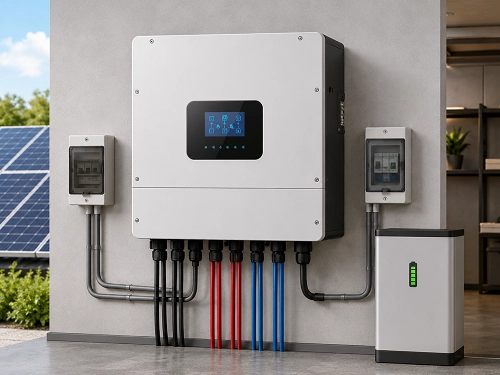
1. What Is a Three Phase Hybrid Inverter?
A three phase hybrid inverter is a power conversion device that combines the functions of a solar (PV) inverter, a battery charge/discharge controller, and an automatic transfer switch into a single unit. Unlike single-phase inverters, which are typically limited to residential-scale loads, three phase units are engineered to balance current across three AC lines (commonly 220/380Vac or 230/400Vac configurations), making them the standard choice for villas, workshops, commercial buildings, and light industrial facilities that run heavier or unbalanced electrical loads such as motors, compressors, and HVAC systems.
The "hybrid" designation means the inverter can simultaneously manage three energy sources — solar PV input, battery storage, and the utility grid (or a backup generator) — and intelligently decide, in real time, which source should supply power based on availability, cost, and load demand. This is fundamentally different from a standard grid-tied string inverter, which cannot operate without the grid and has no battery management capability at all.
2. Core Working Modes: Grid-Tied, Off-Grid, and Grid-Interactive Switching
One of the defining technical requirements of a modern three phase hybrid inverter is its ability to move between operating modes without disrupting connected loads. According to the product specification for the SUNOHOO HS Series, this includes grid-connected, off-grid, and grid-connected/off-grid switching modes, with adaptive frequency support and the ability to configure charge/discharge strategies according to time-of-use (TOU) electricity pricing — allowing facility operators to shift battery usage toward peak-rate hours and reduce overall electricity spend.
A critical detail often overlooked in less capable inverters is behavior during a grid outage when no battery is installed. The HS Series is designed so that, even without a battery connected, it can bypass output so that important loads are not powered off — while its grid-tied electricity-selling function continues to maximize energy utilization when the battery is present. This dual-path design is a meaningful differentiator for commercial sites still in the process of adding energy storage capacity.
3. MPPT Design and PV Oversizing Ratio
Maximum Power Point Tracking (MPPT) efficiency directly determines how much usable energy an inverter can extract from a solar array under varying irradiance and temperature conditions. The HS Series is built with 2 independent MPPT channels, and its PV input is engineered to accept 1.2 to 1.5 times the rated AC output power. In practical terms, an installer designing a system around the HS3120EH48L (12,000W rated output) could oversize the connected PV array up to roughly 18,000W, allowing the inverter to reach full-power battery charging and full-power load supply simultaneously — even during shoulder-season or low-irradiance periods.
This oversizing strategy is standard practice in commercial solar design because it reduces the effective cost per watt of delivered energy and shortens the daily "flat top" clipping window, ultimately improving the economic payback period of the overall system.
4. Protection Architecture: Why "Super Protection" Matters
Grid-interactive inverters carry real safety risk if protection logic is poorly implemented — most notably the risk of unintentional islanding, where an inverter continues to energize a line after the utility grid has disconnected, endangering utility line workers. The HS Series addresses this with AICOT islanding protection alongside a broader protection suite that includes PV reverse-connection alarms, external CT reverse-connection alarms and open-circuit detection, three-phase independent anti-backflow protection, three-phase phase-sequence detection, and zero-ground detection.
Below is a simplified breakdown of the protection layers typically required in a compliant three phase hybrid inverter, mapped against what the HS Series provides:
| Protection Layer | Purpose | HS Series Implementation |
|---|---|---|
| Anti-Islanding | Prevents energizing a disconnected grid line | AICOT islanding protection |
| PV Wiring Safety | Detects incorrect polarity or open strings | PV reverse-connection alarm, open circuit detection |
| CT / Metering Integrity | Prevents incorrect power flow readings | External CT reverse-connection alarm |
| Backflow Control | Prevents unintended export per phase | Three-phase independent anti-backflow |
| Phase Sequence & Grounding | Ensures correct rotation and earthing | Phase-sequence detection, zero-ground detection |
5. Technical Specification Overview — HS Series (HS3085EH48L to HS3150EH48L)
The table below summarizes the key electrical parameters across the HS Series lineup, sourced from the official HS Series product page.
| Parameter | HS3085EH48L | HS3105EH48L/P | HS3120EH48L | HS3150EH48L |
|---|---|---|---|---|
| Rated Output Power | 8500W | 10500W | 12000W | 15000W |
| Battery Voltage | 48Vdc (Lead-acid, lithium, or gel batteries) | |||
| Rated Output Voltage | 220/380Vac ±4%, 230/400Vac ±4% | |||
| Output Waveform | Pure sine wave | |||
| Max Efficiency (Peak) | 92% | |||
| Rated Current | 12.3A | 15.2A | 17.3A | 21.7A |
| Transfer Time | 10ms (typical) | |||
| Max PV Power | 20,000W | |||
| MPPT Voltage Range / Count | 90–800Vdc, 2 MPPT / 1+1 strings | |||
| PV Max Charging Current | 180A ±5A | 200A ±5A | — | 260A ±5A |
| AC Input Voltage Range | Phase: 170–280Vac, Line: 305–485Vac | |||
| Dimensions (W×D×H) | 478×140×625mm | |||
| Weight | 24kg | |||
| Communication | RS485/CAN, optional WiFi/4G | |||
| Certifications | CE, RoHS; IEC/EN 61000-6-1/3, IEC/EN 61000-3-11/12, EN 62920, IEC 62109-1/2, IEC 62321 | |||
Note: The HS3105EH48L is offered in two variants — the "L" version is a standalone unit, while the "P" version supports parallel operation of up to 10 units for larger commercial capacity needs.
6. Environmental Durability and Installation Considerations
Three phase hybrid inverters intended for commercial or industrial deployment need to tolerate a wider range of ambient conditions than typical residential units, since they are often installed in mechanical rooms, rooftop enclosures, or semi-conditioned spaces. The HS Series operates across an ambient temperature range of -25°C to 60°C (with derating above 45°C), tolerates humidity up to 95% non-condensing, and is rated for altitudes up to 4000m (with derating above 2000m). It is wall-mounted and specified for indoor use only, with a removable dust cover intended for harsher industrial environments.
7. Choosing the Right Capacity for Your Site
Selecting between the 8.5kW, 10.5kW, 12kW, and 15kW variants in the HS Series generally comes down to three factors: connected load profile (including motor starting/inrush current), the size of the planned PV array, and whether future parallel expansion is anticipated. Facilities expecting to scale capacity over time may prefer the HS3105EH48L/P variant specifically for its parallel-stacking capability, while single-building sites with a fixed, well-defined load are often better served by the simpler standalone models.
8. About Zhejiang SUNOHOO Technology
The HS Series is manufactured by Zhejiang SUNOHOO Technology Co., Ltd, a subsidiary of Zhejiang SUNOREN Solar Technology Co., Ltd (Shanghai Stock Exchange code: 603105). SUNOHOO operates as a research, design, production, and sales enterprise focused on integrated green-energy storage solutions, with a product portfolio that spans household energy storage systems, industrial and commercial energy storage systems, energy storage batteries, and portable power stations.
The company has been operating since 2008, was recognized as a National High-Tech Enterprise in 2011, and maintains an R&D partnership with Zhejiang University established in 2017. Its engineering work is detailed further on the Technology page, and site-specific deployment examples are covered under Applications. For buyers comparing configurations, SUNOHOO also produces related split-phase hybrid inverters and single-phase hybrid inverters for smaller-scale installations.
9. Frequently Asked Questions
Can the HS Series operate without a battery installed?
Yes. The system can run on PV and grid power combined, and if the grid fails without a battery present, it bypasses output so critical loads stay powered.
What battery chemistries are supported?
Lead-acid, lithium, and gel batteries at 48Vdc are all supported.
Can multiple units be paralleled for larger sites?
The HS3105EH48L/P variant supports parallel operation of up to 10 units, while other models in the range are standalone.
Is this inverter suitable for outdoor installation?
No — per the manufacturer specification, the unit is rated for indoor use only.
Three phase hybrid inverters sit at the center of any commercial or light-industrial energy storage strategy, bridging solar generation, battery storage, and grid interaction into one coordinated system. The SUNOHOO HS Series illustrates the engineering trade-offs involved — MPPT oversizing, multilayer protection, parallel scalability, and wide environmental tolerance — that determine whether a hybrid inverter can reliably serve as the backbone of a facility's power architecture. Readers evaluating a system for their own site can review full specifications and request project-specific guidance directly through SUNOHOO's product inquiry page.